
Jeffrey Alexander on Steve Marcus – Tomorrow Never Knows 

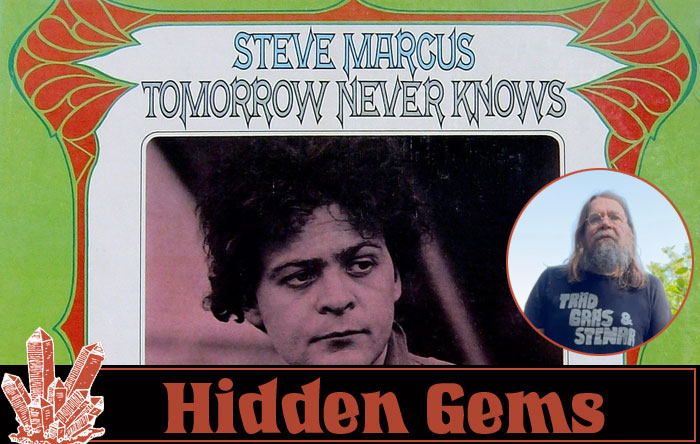

There’s always room around here for site regular Jeffrey Alexander. In the wake of the band’s latest, Jeffrey’s having a second go at the Hidden Gems series. A consummate music archeologist, Alexander’s always good for a gem that I’ve never dug into and the latest is no exception. Check out his dive into the debut from Steve Marcus, a jazz take on ‘60s psych and pop.
“Hey, what’s up RSTB freaks? It’s me, Jeffrey Alexander, here to bring you another Hidden Gem that you might dig. It’s the first album from jazz saxophonist Steve Marcus, released in 1968 on the Vortex label. In fact, it was the first ever release for that label. Coincidentally, the only other time that I presented a Hidden Gem for this site – over six years ago – was also for an album on Vortex. A short-lived weirdo jazzy branch of Atlantic Records, Vortex only released fourteen albums total between 1968 and 1970 – all distributed by ATCO. But holy cow what a lineup: Sonny Sharrock, Byard Lancaster, Robin Kenyatta, Chick Corea, to name a few! This label – yowsa! If I return here again in another six years, my next Hidden Gems will surely be Dave Pike’s “Doors Of Perception”. During their brief existence, the Vortex label highlighted free jazz, modal explorations, psychedelic and folk rock, as well as early fusion experiments. You know, all the good shit.
“Tomorrow Never Knows” from Steve Marcus features all of these vibes. This amazing album has Marcus backed by most of the members of The Free Spirits including fusion savant Larry Coryell on electric guitar and the uncompromising rhythm section of Chris Hills and Bob Moses (all three of whom were uncredited). Visually, the cover is another simple, yet timeless pop-art sleeve from legendary designer Haig Adishian. That’s why I originally pulled it out of the stacks while exploring my college radio station library in the 80s. Adishian created hundreds of jackets for Atlantic (and subsidiaries Cotillion, Stax, Embryo, etc) – everything from Vanilla Fudge to the iconic op-art band logo for Yes. And of course, the LP was produced by none other than flute-meister Herbie Mann. Overall, quite the pedigree.
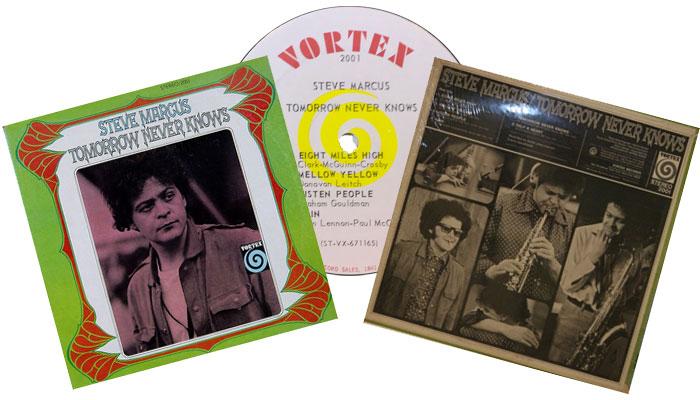
And the music, oh yes – the music. Marcus kicks it off with a killer cover of The Byrds’ Eight Miles High. This is the stuff right here! Although the folksy jingle-jangle starts innocently enough, it doesn’t take long for the jam to reach a fever pitch with guitar and sax wrestling wildly before the coming back to Earth for the next chorus. Coryell is mostly panned left while New Zealand keyboardist Mike Nock of the Fourth Way band (also uncredited) is primarily in the right channel with his Fender Rhodes running through a barrage of pedals and ring modulation. While the Hüsker version has long been my favorite aside from the original, this one hits all the right zones, especially for an instrumental take without the benefit of a growling snarl. Its by far the best, headiest track on the LP – such a great start!
A cover of Donovan’s Mellow Yellow follows, which begins on the straight and narrow – almost comically music hall cliché – until it ever so slowly goes delightfully off the rails. First with Nock plunking and hand sliding piano strings at random in the right channel and then Marcus’ second sax part (a full-on free-skronk overdub) consumes the entire vibe. The joke’s on us. After that is Listen People, a somewhat forgettable Herman’s Hermits cover (well, you can’t have everything), but Coryell’s excellent electric fingerpicking and the swinging backbeat thankfully keeps things moving along. This is, after all, a major label release from 1968 – I bet Herbie Mann pushed for the Hermits track, but we’ll never know.
Next up are a pair of Beatles tunes, where things really get cooking again. In line with Marcus’ usual approach, Rain starts off sober and slowly but surely gets weird. The rhythm section is as locked in as ever, Coryell is getting frantically far out, while Nock’s modal piano chords are stabbing things perpetually forward. Throw in a bit of fuzz, and you get a lovely odd stew of garage jazz. This is succeeded by the title track: 100% primo avant raga, clocking in at over eleven minutes. A heartbeat of bass thump with right channel drum rolls make the bed, while the leads all take their customary turns. Coryell starts with a gauze of acidy wah washes and oozy serpentine lines while Nock returns to acoustic piano with a classic hard bop solo reminiscent of his time playing with Art Blakey’s Jazz Messengers (who he played with in 1965-66, where he replaced Keith Jarrett). Marcus then brings it all in for a safe landing – all in all quite satisfying.
The final track, Half A Heart, ends the record on sort of a let-down, as its a bit of a throw-away, similar to Listen People. Its redeeming feature, however, is a lovely two-plus-minute middle section filled with Nock’s effected keyboard mimicking a delightfully Doors-y harpsichord. But perhaps the most interesting thing about this track is the multi-faceted mystery surrounding it. First of all, the copyright lists vibraphonist Gary Burton (whom Marcus went to Berklee with) as songwriter, although Burton has no memory of this. More importantly, Marcus’ sax riff was ripped off wholesale for Gerry Rafferty’s 1978 monster hit Baker Street. Rafferty’s sax player Raphael Ravenscroft claimed to have never heard Half A Heart. Yeah, right. This is even more ridiculous to me as Larry Coryell released his own version of the song on his Vanguard LP “Basics” – this one featured Bernard Pretty Purdie on drums and Ron Carter on bass. It was originally recorded in 1968, just a few months after the Steve Marcus version, but not released until 1976 while Rafferty was in his Baker Street flat in London writing and recording his demos for City To City (Uh huh). Interestingly, Coryell took songwriting credits away from Gary Burton for his version – presumably because he added lyrics (and sang!), but who knows? There are so many questions. There is an Atlantic article from 2015 that touches on some of these discrepancies, but without any mention of the Coryell version and even a few factual inaccuracies regarding Steve Marcus’ work. Journalism!
Side note: If you are tempted to do a side-by-side listen to these on your own, for Baker Street I would strongly recommend going with the far superior Prince Ass version! Sweaty, mustachioed, track-suited members of Barnacled, V Majestic and The Eyesores. Recorded live at AS220 back in 2003, an arts space in Providence that I booked as Program Manager for several years, its a real treat. Incidentally, after leaving Rhode Island a few years later, Miriam and I ended up buying a house in Pittsburgh that was actually on Baker Street – this amused Prince Ass to no end.
Well there you have it: Steve Marcus – “Tomorrow Never Knows” in a nutshell. The fact that this LP – as well as nearly every other Vortex record – disappeared almost immediately after release, easily puts that label’s output into the “Hidden” zone already. The two standout pieces here, Tomorrow Never Knows and, especially Eight Miles High, really push this one into “Gem” territory for me. Both of those tracks have popped up on various mix tapes and radio shows of mine for decades. Dive in to this one for some great experimental psychedelic jazz – enjoy !
A thoroughly heady listen right here, and all the better for the historical context and dishy trivia served up by Alexander. The record is available digitally for the curious, but it won’t break the bank on a copy if you can find one in the States either. Seems like quite a few are sitting in Japan if you’re comfortable with some shipping as well. A nice companion to The Heavy Lidders’ latest, a psychedelic scorcher that seeks out the corners of jazz and improv as well. The new Heavy Lidders album, Liquid Donnon, is out now.
Support the artist. Buy it HERE.